Blog
I Lived in a Multi-Generational Home and Here’s What It’s Really Like
Published 29 May 2026
TL;DR / Summary:
– Multi-gen living has real perks: family support, shared bills, and built-in company.
– But privacy is limited, house rules are unspoken, and wanting things just for yourself comes with guilt.
-It works best when boundaries around space, money, and expectations are set early.
– Whether to stay or move out depends on your situation, your family dynamics, and how much alone time you need.
I’ve experienced living with my entire extended family under one roof, and the trade-offs are real: the warmth and support, yes, but also the lack of privacy, the compromises you never signed up for, and the guilt of wanting your own space.
If you’re living this right now or considering it, here’s the honest version, from someone who’s been there.
Table of Contents:
- Let's Be Honest, There's a Lot to Love About Multi-gen Living
- The Not So Fun Part About Multi-gen Living
- Singapore Literally Built the System Around This
- Where Things Usually Get Complicated
- How to Actually Make Multi-generational Living Work
- So, Should You Stay or Get Your Own Place?
- The Trade You're Actually Making
- Find a Home That Works For Your Family
- Frequently Asked Questions

Let’s Be Honest, There’s a Lot to Love About Multi-gen Living

Multi-gen living is pretty normal in Singapore, and honestly there are genuine reasons why so many families still choose it.
Just knowing your family is right there, a room away, means you’re not constantly worrying about them. Ah Ma is right there in the kitchen, probably giving you grief about your sleep schedule again. It’s annoying, but it’s proof she’s okay.
The financial side of it is obvious, but it’s still the biggest one. Sharing the mortgage, the groceries, and the utilities. It’s a massive game-changer. For me at least, not having to shoulder rent on my own meant I could actually save a significant chunk every month instead of watching my salary disappear almost immediately.
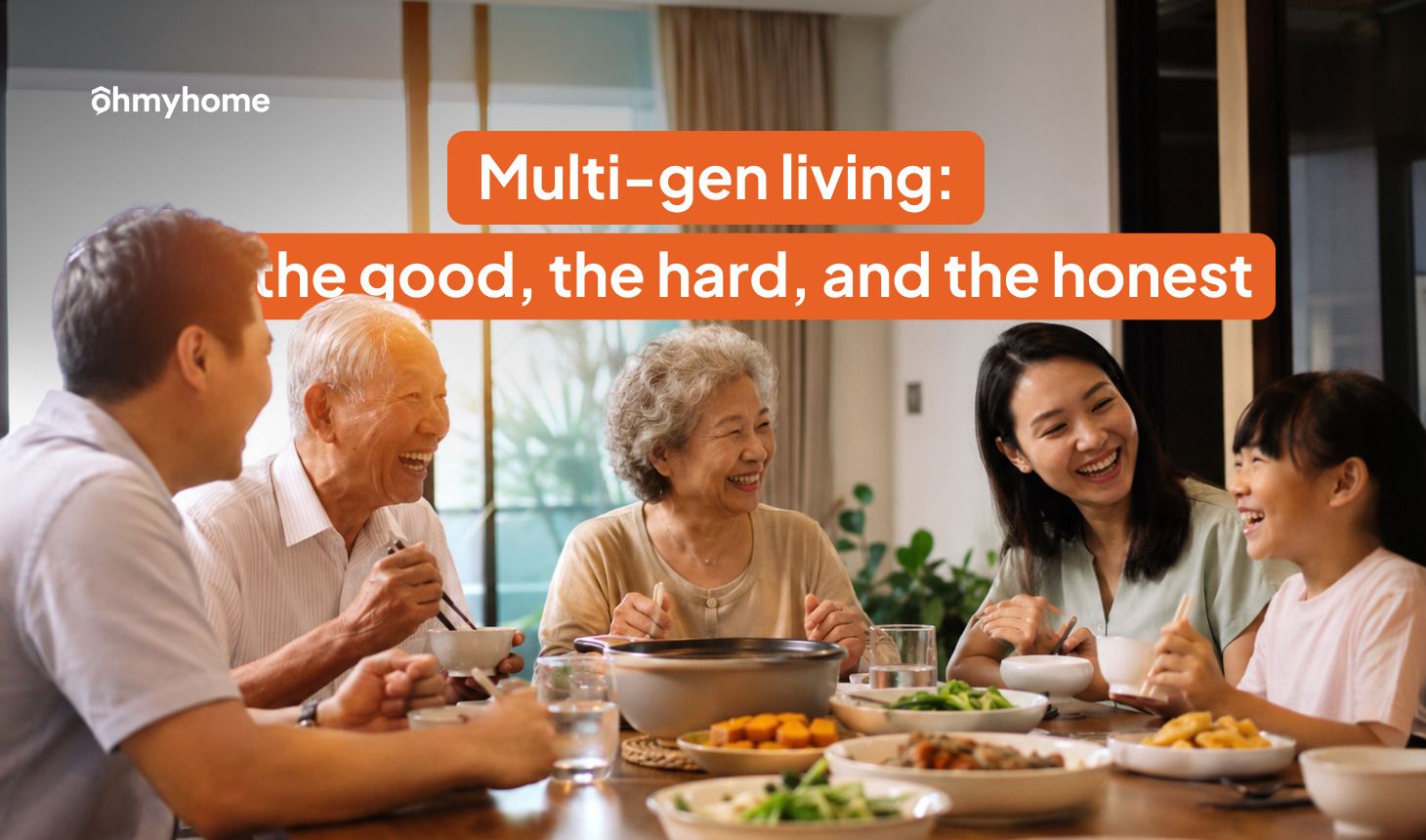
And the loneliness piece is underrated. Multi-gen homes are loud but rarely empty. There’s always someone to debrief with, someone to share food with, someone who noticed you came home late. When you live alone, you can go weeks feeling invisible. That doesn’t happen when three generations share a dining table.
The Not So Fun Part About Multi-gen Living

The hard stuff isn’t one big thing. It’s the small stuff that builds up over time. Every decision you make, even the tiny ones, somehow involves or affects everyone else in the house. You can’t really do anything just for yourself without it becoming a group matter.
And forget having a disagreement with your partner in private, the whole house somehow knows about it before you’ve even resolved it yourselves. It’s not just the big moments either. Even something as simple as ordering food delivery becomes a whole thing.
I remember ordering food delivery once and my Ah Ma said “why did you only buy food for yourself?” I mean, I would tapao for everyone but that’s easily a $60 order and I’m not out here printing money. Somehow wanting one meal to myself feels like a crime…
Then there are the invisible house rules nobody discussed because they predate you. Kitchen arrangements. Aircon temperature. When quiet hours start. Nobody negotiated these. They just exist. And you either absorb them or cause friction every time you push back.
Singapore Literally Built the System Around This

Singapore’s version of multi-gen living has its own flavour. The Married Child Priority Scheme, the three-generation flat, the option to ballot near your parents’ estate. The government literally built infrastructure and financial incentives for families to stay together.
Which is thoughtful. And also means a lot of Singaporeans end up in multi-gen arrangements not entirely by choice.
So be honest with yourself: did you choose this because you genuinely wanted to, or because have you seen what a resale flat costs these days? Both are completely valid and way more common than people admit. The experience just tends to feel a bit different depending on where you’re coming from, and that’s completely normal.
Where Things Usually Get Complicated

From what I’ve seen and honestly lived through, the friction is rarely about one big thing. It’s usually the slow accumulation of smaller ones:
An adult child who’s now earning their own income but still gets treated like they’re seventeen.
A parent who’s been covering household costs for years and never once heard a thank you.
A spouse who moved into their partner’s family home and never quite stopped feeling like a visitor.
A grandparent who suddenly has no say in a house they’ve lived in for decades.
None of these things explode. They just sit there and build. And by the time anyone actually addresses it, there’s usually months worth of unspoken frustration underneath the surface. I’ve seen arguments that were technically about the aircon but were really about everything else that never got said.
And the worst part is, most of it could have been avoided if people just said something sooner.
How to Actually Make Multi-generational Living Work

Making multi-gen living for Singaporeans work isn’t about everyone getting along. It’s about everyone knowing where the lines are.
1. Designate one space that’s yours, non-negotiable
With everything else already shared, your bedroom is the one thing worth protecting. Mine was where I’d go when I just needed to switch off from everyone and everything, no conversations, no family updates, just my own space to breathe and recharge. Honestly if there’s one thing I’d tell anyone moving into a multi-gen setup, it’s to treat that room as non-negotiable from day one.
2. Have the money conversation
Seriously, just have it. Who covers what, how the bills get split, who buys groceries. It feels a bit awkward to formalise but trust me it’s so much better than figuring it out after the fact. “We’ll just chip in when needed” sounds fine until two months in and someone’s quietly keeping score.
3. Set some house rules everyone can live with
For us it was simple stuff. After 10pm the house winds down, everyone does their own thing and nobody starts a whole new conversation. Weekends we eat together at least once. It sounds almost too small to matter but honestly those two things alone kept the atmosphere from getting too tense during the week. Pick a few house rules that work for everyone and just stick to them.
4. Let small things go, and name the big ones early
Not everything needs to be addressed, some things you just let slide and move on. But the stuff that genuinely bothers you, say it early. In my experience the arguments that got really ugly were never actually about what they were supposedly about. Someone blew up over dishes but it was really about feeling unappreciated for months. Say the thing when it’s still a small thing, not when you’ve already been stewing over it for weeks.
5. If you have a partner, be a united front
This one matters enormously. Your partner should never feel like they’re alone in navigating your family dynamics. Whatever you’ve decided together, you show up presenting the same thing. A household with multiple generations is already a lot to manage, and a couple that isn’t on the same page just adds another layer of tension nobody needs.
So, Should You Stay or Get Your Own Place?
Here’s an honest way to think through it:
Stay in a multi-gen setup if:
- You genuinely like the people you’d be living with, not just love them
- You have young kids and grandparent support would be real and consistent
- You’re early in your career and the financial breathing room is meaningful
- You can set boundaries without it becoming a family incident
Consider getting your own place if:
- You or your partner already feels like a guest in someone else’s home
- The invisible rules are causing friction that never fully resolves
- You need quiet to function, mentally or creatively, and you’re not getting it
- You’ve been compromising so long you’ve lost track of your own preferences
For me, the decision to eventually move out had nothing to do with me hating my family. It was more that I hit a point where I just wanted to come home late without a full debrief at the door. Order takeout without a comment. Small things, honestly, but they add up when you’ve been under a set of watchful eyes your whole life.
That said, everyone’s situation is different. If you’re living with a partner, have kids, or have family members who genuinely depend on each other, the calculus looks completely different. There’s no universal right answer here, just the one that actually fits your life.
The Trade You’re Actually Making

Multi-gen living isn’t a compromise. It’s a trade. Privacy for presence. Autonomy for security. Silence for belonging.
The families that thrive aren’t the ones who pretend the friction doesn’t exist. They’re the ones who decided the good stuff was worth the hard stuff, not because the hard parts went away, but because they stopped waiting for them to.
If you’re still figuring out which side of that trade makes sense for you, the right property and layout goes further than most people expect. A well-designed 3-gen flat or an HDB near your parents’ estate makes the day-to-day far more manageable than you’d think.
Find a Home That Works For Your Family

Thinking through your next move? Ohmyhome‘s Super Agents would love to help you find the right unit for your family setup, whether that means finding a place big enough for the whole family, staying close to your parents, or finally getting a space of your own.
Submit your preferences to us: how many rooms you need, the type of unit, your preferred location, whether it’s for a multi-gen family or just the two of you, and we’ll match you with the most suitable options that actually fit your situation.
Have questions or not sure where to start? WhatsApp us and we’ll help you figure it out.

Frequently Asked Questions
1. Is multi-generational living worth it in Singapore?
Multi-generational living is worth it if your family communicates well and has aligned expectations going in. The financial benefits are real and the built-in support system genuinely helps, especially for young couples and families with young kids. But without clear boundaries around space and money, the same arrangement that saves you stress can quickly become the source of it.
2. How do I set boundaries with family when living together?
The clearest way is to have the conversation early, before resentment builds. Agree on the basics upfront: who has claim to which spaces, how expenses get divided, and what the house rules are. Boundaries in a multi-gen home rarely fail because people are unreasonable. They fail because nobody sat down and talked about them in the first place.
3. Should I buy a 3-gen flat or just live near my parents?
A 3-gen flat works best if you want to share daily life together, meals, childcare, expenses, all of it under one roof. Living nearby gives you the closeness without giving up your own space and routine. If you still want independence but don’t want to be far when something comes up, living near your parents is usually the better fit.