Blog
How to Spot Property Agent Impersonation Scams in Singapore
Published 7 August 2025
TL;DR / Summary:
– Spot a scam by checking for mismatches: an agent missing from the CEA Public Register, inconsistent listing details, or pressure to pay before viewing.
– Always verify an agent’s registration and disciplinary record on the CEA Public Register first.
– Property scams have cost Singapore millions in losses, with cases involving fake rental deposits and vanishing “agents.
It appears that scammers have been working overtime in recent years. As an industry where large transactions are handled frequently, it was only a matter of time before real estate customers would be targeted with a property scam in Singapore.
Table of Contents:
- First, Learn How to Verify a Property Agent
- Victims of Property Scams Unlikely to Retrieve Lost Money
- How to Differentiate Between Fake and Legitimate House Listings
- What Requirements Does CEA Have for Property Advertisements?
- Things That Legitimate Property Agents Will Never Do
- Prepare for the Worst: Scams Powered by AI
- Find Your Home with a Peace of Mind
- Frequently Asked Questions
First, Learn How to Verify a Property Agent
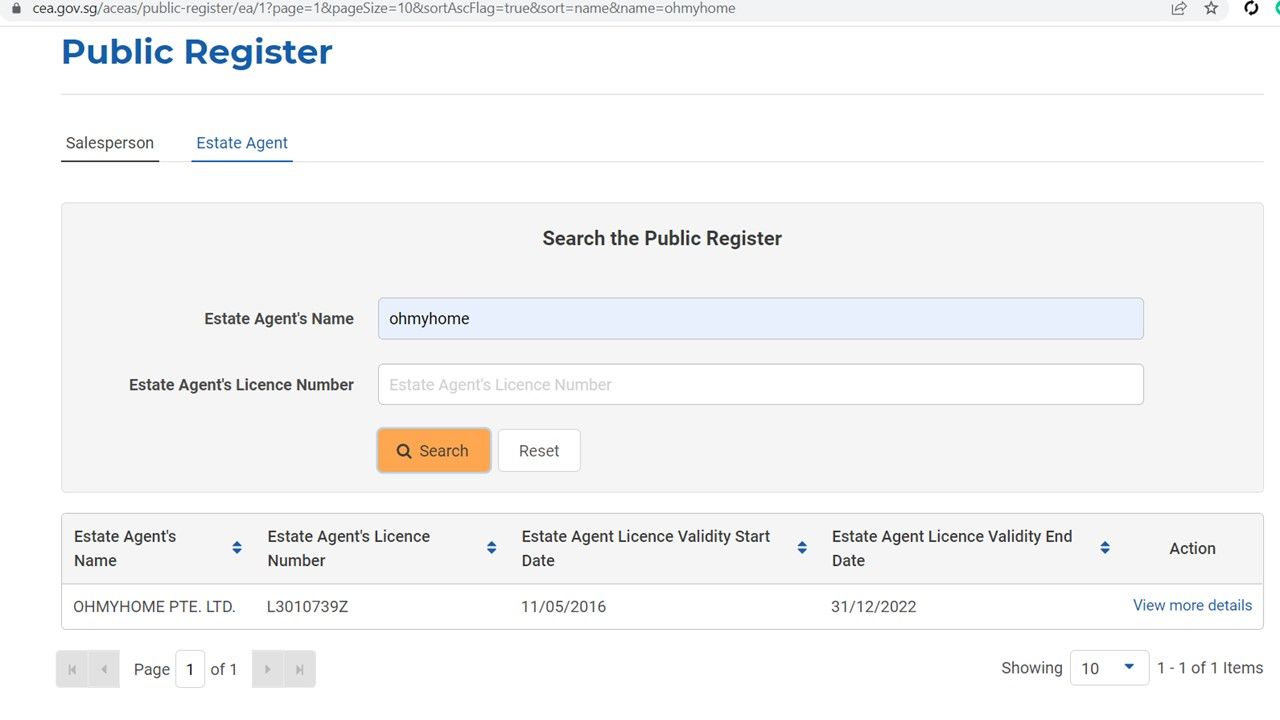
All property agents in Singapore are legally required to be registered with the Council for Estate Agencies (CEA) through a licensed property agency, such as Ohmyhome. Before entering negotiations with any property agent, checking their registration status on the CEA Public Register will serve as the first step in verifying their legitimacy.
Related Blog:How to Check Property Agent Transaction Record in CEA Public Register
Home buyers can key in details of their property agent, including their unique CEA registration number (e.g., R123456A), into the CEA Public Register portal. From there, they can access the following details about the property agent:
- Property transaction history of all deals closed within the last three years
- Accolades and awards that they may have earned throughout their career
- Whether they are suspended or had their licence revoked
- Enforcement actions taken against them over the last three years, including Letters of Censure, Disciplinary Committee decisions, and court prosecutions
This gives you the best bet in making an informed decision when choosing a property agent to work with. If they cannot be found on the registry, they are most likely illegally practising or a fake property agent. Either way, that will be your cue to hightail out of that situation.
You can also use this opportunity to cross-check a realtor’s credentials to see if they have been upfront and honest with you. If you’re choosing a home to buy or rent, you’ll want an agent who is 100% transparent about who they are and someone you can trust to point out flaws, damages, or constraints within a home before you find out for yourself.
View this post on Instagram
A post shared by Ohmyhome (@ohmyhomesg)
Victims of Property Scams Unlikely to Retrieve Lost Money
Tenants and home buyers have been hit hard. Singapore officials saw at least 1,000 victims lose close to $4 million between January and September 2022 due to numerous fake property agent or impersonation scams. Additionally, around $2.7 million was lost to property rental scams between January and November 2024.
These scams haven’t slowed down since. In July 2025, police arrested a woman linked to at least 32 separate room rental scams, with victims paying deposits between $300 and $3,600 before she allegedly cancelled the agreements and disappeared without delivering on the units, racking up losses of more than $48,500.
This appears to be the latest trick in the scammers’ playbook. Using the publicly available details of legitimate realtors, scammers have convinced prospective tenants to fork out hundreds or even thousands of dollars in deposits to secure slots for alleged ‘property viewing’ sessions. To convince their victims of their credentials, the scammers would send the property agent’s business card.
Property agents who were unfortunate enough to have their identities stolen had to endure heated calls from understandably angry customers who were ghosted once transactions were complete.
While police authorities and property agencies are aware of the situation, victims of this latest string of swindling cases are unlikely to retrieve their money. It is thus important for home tenants and buyers to act as the last line of defence for themselves by learning how licensed, legitimate property agents operate, as well as the common tactics of realtor impersonators.
How to Differentiate Between Fake and Legitimate House Listings
Beyond verifying the property agent, the listing itself usually gives something away if you know what to look for.
Watch out for:
- Rent priced noticeably below market rate for the area and unit type, often used to create urgency and rush you into committing.
- Stock-like or overly polished photos that don’t match the unit’s actual layout or condition.
- The same listing posted across multiple platforms with slightly different contact details each time.
- No exact unit number or block given, or a lister who refuses to confirm the unit’s specific location.
- A phone number that doesn’t match what’s listed on the CEA Public Register, even if the agent’s name and registration number check out.
- Contact limited to WhatsApp or Telegram only, with no option for a call or in-person meeting.
- Pressure to pay immediately, often with claims that someone else is viewing the unit today or that a deposit is needed just to “secure” a viewing slot.
A legitimate listing won’t ask you to rush, and a legitimate agent won’t mind you taking the time to verify.
What Requirements Does CEA Have for Property Advertisements?
Sometimes, the house listing advertisement reveals whether or not a property agent is legitimate. Instead of going through the hassle of keying in their personal details into CEA, some scammers give themselves away by not including all the CEA-required details in their ads.
According to CEA’s Advertising Guidelines for Estate Agents and Salespersons, all property commercials must include the following details:
- Estate agent or salesperson’s name
- Estate agent or salesperson’s licence number
- Estate agent or salesperson’s CEA registration number
- Estate agent or salesperson’s official business contact number
On top of that, advertisements must abide by the Practise Guidelines on Ethical Advertising and the Code of Ethics & Professional Client Care. This includes the display of legitimate photos in their unadulterated form and proper substantiation of any promotions or claims of investment opportunities.
Any real estate agent worth their salt would follow these guidelines closely, or risk having their licence revoked. So, look out for these details and save yourself some valuable time from dialling for illegitimate agents.
Also, keep in mind that newspaper classified advertisements and phone text adverts only require two details: the property agent’s name and phone number. For these specific media, the agent’s name can be in abbreviated form due to physical constraints (e.g., limited character count or page space).
Things That Legitimate Property Agents Will Never Do
As some unsuspecting home viewers found out, verifying an agent’s identity is not a foolproof way of protecting yourself against scams. Some scammers have even gone as far as creating fake identity cards to add to their illusion of legitimacy.
But no matter how convincing their facade is, scammers will not be able to fully emulate the professionalism and service delivery of actual real estate agents. The former seeks to attain money from you in exchange for nothing, while the latter is an expert in helping you seek a roof over your head. Because their goals are different, the behaviour of scammers will deviate from that of a legitimate agent at one point or another.
Things that a real property agent will never do include:
- Request money for viewings upfront: Not only does CEA not authorise property agents to handle cash transactions, but property agencies also do not charge money for home viewings, let alone for houses that viewers have not ever stepped foot in. Property agencies will never ask tenants or buyers to transfer money directly into a personal savings account. If you’re ever in doubt, contact the agency that the listor claims to be representing to verify if the transactions being requested are legitimate.
- Quote unrealistic dimensions and prices for homes: As experts in the housing market, property agents know the dimensions and prices of homes inside and out. One reported scammer claimed that a listed 3-bedroom unit was only 140 sq ft in size. This is where seeking a second opinion and doing your market research comes in, because anyone familiar with houses in Singapore would know that 140 sq ft is the average size of one room, not an entire 3-bedroom unit.
- Contact you with an overseas number (if you are in Singapore): As of April 2020, telcos have added the +65 prefix to caller IDs to alert the public that they are being contacted from overseas. Unless you are expecting a call from abroad, a best practice would be to avoid picking up calls or responding to messages from these numbers.
Should you suspect any online property listing to be fraudulent, you may submit a report to the Singapore Police Force via telephone at 1800-255-0000 or their I-Witness portal online.
Prepare for the Worst: Scams Powered by AI
AI has been proven helpful in many industries since it became more widely available to the public. Unfortunately, it’s now also possible to use it to defraud people, and it’s only a matter of time before impersonators or property scammers tap into the technology to commit crimes.
While no AI property scams have been recorded as of the time of publishing this post, it’s only logical for you to prepare for this possibility to avoid falling victim. After all, the CEA database may not be as helpful when that time comes.
The Cyber Security Agency of Singapore and the Government Technology Agency have released guidelines on how the public can differentiate fake from real videos, images, or audio and report instances of digital manipulation.
Find Your Home with a Peace of Mind

Finding a place to call home shouldn’t come with this much worry. Which is why at Ohmyhome, we ensure all our Super Agents are CEA-certified and verifiable on the public registry. Our listings are Singpass-verified too, so you always know exactly who and what you’re dealing with.
If you’re buying a new home, simply submit your preferences to us and let our data-matching algorithm do all the work. Our Super Agents will contact you via WhatsApp the moment a match is found.
On the other hand, if you’re selling your home, you can get a free property valuation with Homer AI before connecting with a Super Agent to find a genuine buyer.
Whichever stage you are in your property journey, Ohmyhome ensures you’ll be doing it the safe and secure way.
WhatsApp us to get started!
Frequently Asked Questions
Can a property agent legally ask me to pay them directly instead of the landlord or seller?
No, property agents are not allowed to collect transaction monies like rental deposits or sale proceeds. Those payments must go directly to the landlord or seller. Agents are only entitled to collect their commission, and even that should be agreed upon and documented beforehand, not paid upfront before any service is rendered.
Why do some scam listings still show a real CEA registration number that checks out?
Scammers often steal a legitimate agent’s public details, including their registration number, since this information is publicly searchable. The number checking out doesn’t confirm you’re speaking to that agent. What matters is whether the phone number you’re using to contact them matches the one tied to that registration on the CEA Public Register.
Can I verify a property agent’s identity through means other than the CEA Public Register?
The CEA Public Register remains the most reliable source, since it’s the only official record syncing an agent’s name, registration number, and phone number. You can also call the agency directly using contact details from their official website, not the listing, to confirm the agent is currently representing that specific unit.
Should I be worried if an agent asks for my NRIC or personal details before a viewing?
A legitimate agent typically only requests personal particulars once you’re proceeding with an actual tenancy agreement or transaction, not before a viewing. If you’re asked for NRIC, passport scans, or financial details upfront, before you’ve even seen the unit, treat that as a reason to pause and verify further.
Header Image Source: Freepik