Blog
How to Choose a Property Agent in Singapore (2026)
Published 28 May 2025

Finding a good property agent in Singapore comes down to three things: CEA registration, relevant specialisation in your property type, and a verifiable track record. The rest: personality, fees, and agency size, matters too, but only after these fundamentals are in place.
Think of it like finding a good hawker stall. There are plenty around, but only a few are worth queuing for. Your friend’s recommendation might be well-intentioned, but your taste is your own, and so is your housing situation.
This guide walks you through exactly how to vet, compare, and choose the right property agent for your needs, whether you’re buying or selling an HDB flat, condo, or landed home.
TL;DR / Summary:
– Verify CEA registration at cea.gov.sg before anything else.
– Match your agent to your property type. HDB, condo, and landed specialists are very different people.
– Check their actual transaction history on the CEA Public Register, not just their word.
– Before committing, confirm they’re responsive, data-driven, and have a clear plan for your property.
Table of Contents:
- Step 1: Make Sure Your Agent Is CEA-Registered
- Step 2: Find an Agent Who Specialises in Your Property Type
- Step 3: Vet Your Agent Based On Your Property Type
- Step 4: Watch Out for Property Agent Red Flags
- Step 5: Check How Responsive and Communicative Your Agent Is
- Should You Go with a Major Agency or Independent Agent?
- Use This Property Agent Checklist Before You Commit
- Not Sure Where to Start? We Can Help.
- Frequently Asked Questions
Step 1: Make Sure Your Agent Is CEA-Registered
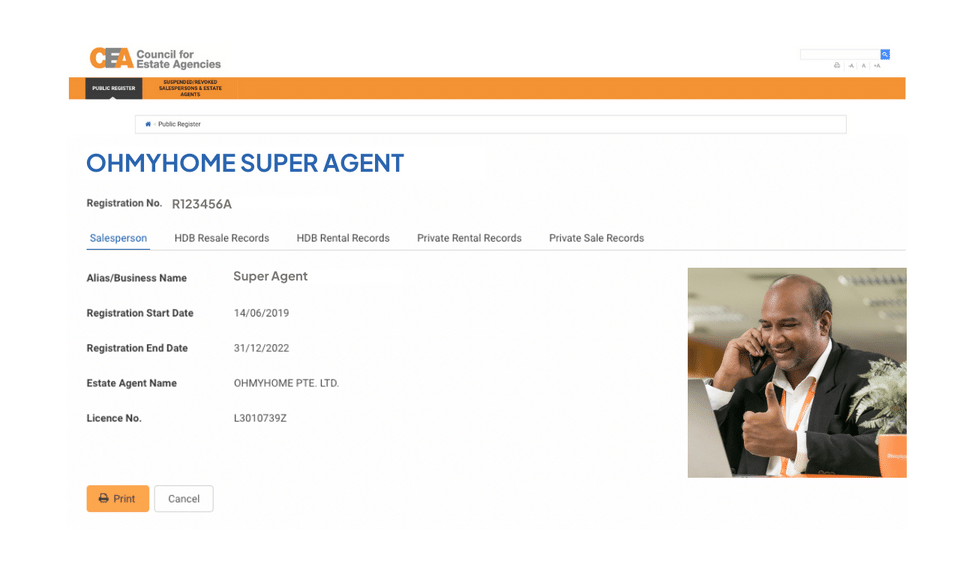
This criteria is non-negotiable. The Council for Estate Agencies (CEA) legally requires all practising property agents in Singapore to be registered with their respective property agencies. Real estate agents operating without a licence can be fined up to $75,000 and imprisoned for up to three years.
While you won’t be directly slapped with fines, you definitely won’t want to become collateral damage after your property agent’s illegal activities have been discovered, either.
How to Verify a Property Agent’s CEA Registration
- Visit the CEA Public Register at www.cea.gov.sg
- Search by the agent’s name, mobile number, or CEA registration number
- All registered agents have a unique 8-character registration number (e.g., R123456A)
- Confirm that their name, contact number, and agency details match what they’ve given you
💡 Note: CEA-registered agents are also legally prohibited from representing both buyer and seller in the same transaction. If an agent suggests this arrangement, treat it as a red flag.
You can refer to our “Guide on Checking A Property Agent’s Record in CEA Singapore” for more information.
Step 2: Find an Agent Who Specialises in Your Property Type
As much as property agents say they’re a jack of all trades, most are likely a master of one. While this is not always the case, most property agents will specialise in transacting a certain type of property, be it a HDB or private property. And honestly, that may be better for you.
Property Agent X may be better at selling resale HDB flats, and Property Agent Y at private properties. Who do you choose between the two?
It’s simple: The agent who sells the type of property you’re selling too.
So if you’re selling an HDB flat, it would do you good to find a property agent who’s had proven success in selling HDB flats.
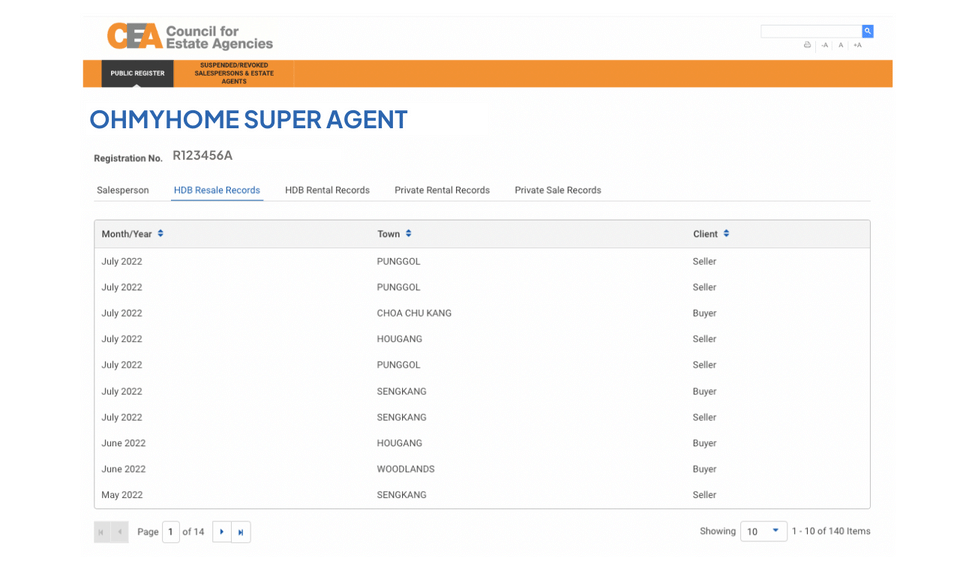
You can verify this directly on CEA’s Public Register. Once you find an agent’s profile, click ‘View more details’ to see their completed transaction history, broken down by:
- HDB Resale Records
- HDB Rental Records
- Private Rental Records
- Private Sale Records
💡 Note: CEA transaction records are updated on the 15th of every month, and show completed transactions from the past year from date of access. The records also show which towns or districts each transaction was in, so you can see not just what type of property an agent handles, but where they’ve built their strongest presence.
Step 3: Vet Your Agent Based On Your Property Type
Different properties call for different expertise. Use the breakdowns below to vet your agent based on exactly what you’re selling.
Finding the Best Property Agent for HDB Transactions

Buying or selling an HDB flat involves a distinct set of rules, portals, and eligibility requirements that don’t apply to private property. You want an agent who navigates this system daily.
Experience to Look For
✅ Fluent with the HDB Resale Portal, from registration to completion.
✅ Familiar with the Ethnic Integration Policy (EIP) quotas that affect who can buy in your block.
✅ Knowledgeable about buyer financing options: CPF usage, HDB loans, bank loans, and how each affects the valuation gap.
✅ Up to date on available CPF Housing Grants (Enhanced, Proximity, Step-Up) and how they influence buyer eligibility.
✅ Experienced in managing Cash Over Valuation (COV) situations.
Qualities to Look For
✅ A genuine buyer network in your town, especially first-time buyers and young families actively looking in your area.
✅ Deep knowledge of resale demand in your specific estate, since different towns have very different buyer pools.
✅ A patient, process-oriented approach, as HDB transactions involve multiple stages and official timelines.
Questions to Ask
“How many HDB resale flats have you transacted in this town in the past 12 months?”
“How do you approach pricing given the current valuation, and how do you handle COV if it arises?”
“Can you walk me through how you assist with the HDB Resale Portal and required documentation?”
Typical Commission
Around 2% for the seller’s agent. A buyer’s agent, if involved, typically charges 1%, usually paid by the buyer.
Confirm upfront whether GST or marketing fees apply.
Finding the Best Property Agent for Condo Transactions
Private residential transactions run on a different set of rules. ABSD rates, foreign buyer demand, new launch competition, and investor behaviour all shape how your unit gets priced, marketed, and sold. Your agent needs to understand all of this, not just get your listing live on a portal.
Experience to Look For
✅ Familiar with your specific development or comparable projects nearby, to the point where they can cite recent transacted prices without needing to look them up.
✅ Understands how new launches in the vicinity affect resale pricing and buyer interest.
✅ Clear on how ABSD rates and TDSR affect different buyer profiles, given that Singaporeans, PRs, and foreigners will all approach your unit differently.
Qualities to Look For
✅ Strong marketing execution: professional photography, home staging capability, and ideally 3D virtual tours.
✅ Able to tailor their pitch to different buyer motivations, since an investor cares about yield while a homeowner cares about schools and lifestyle.
✅ Flexible with viewing schedules, including evenings and weekends.
Questions to Ask
“Can you share details on similar condos you’ve sold recently, including the prices achieved and time on market?”
“What’s your plan for positioning and pricing my unit competitively against current listings?”
“Do you co-broke with buyer agents, and how do you structure that arrangement?”
Typical Commission
Around 2% for the seller’s agent. For higher-value units this may be negotiable down to 1.5% or structured as a tiered arrangement.
Clarify upfront whether a buyer’s agent is paid separately or through a co-broking split.
Finding the Best Property Agent for Landed Property Transactions

Landed property is a category apart. The buyer pool is smaller, the sales cycle is longer, pricing depends significantly on land value and redevelopment potential, and deals often involve high-net-worth clients with very specific requirements. General experience is not enough here.
Experience to Look For
✅ In-depth understanding of how landed property is priced, including the relationship between land value, built-up area, and potential for rebuilding or additions.
✅ Familiar with URA zoning regulations and what’s permissible in terms of redevelopment, additions, or alterations.
✅ Comfortable working with high-net-worth buyers, including those represented by wealth managers or legal advisors.
Qualities to Look For
✅ A transaction record specifically in landed property, not just broad residential experience.
✅ Strong buyer screening capability: they should know how to filter out casual inquiries and focus on qualified prospects.
✅ Access to high-end marketing tools: drone photography, exclusive private tours, and targeted outreach to the right networks.
Questions to Ask
“Can you give examples of landed homes you’ve sold in this district, with prices and time on market?”
“Are you able to advise on the rebuild or development potential of my property?”
“How do you reach serious, qualified buyers? Do you work with wealth managers or co-broke with specialist agents?”
Typical Commission
Commission typically ranges from 1 to 2% of the sale price and is often negotiable for higher-value deals.
Top-tier landed agents with strong networks and a track record in GCB or premium landed segments may command a premium, and in most cases it is justified.
How to Know If Your Property Agent Can Find You Buyers
Being able to match sellers with buyers, or buyers with the right listings, may very well be the hardest part of the job for property agents.
And not everyone has access to the kind of technology that automatically does the seller-buyer matching for property agents, making it that much quicker for your home to be sold to the right buyer.
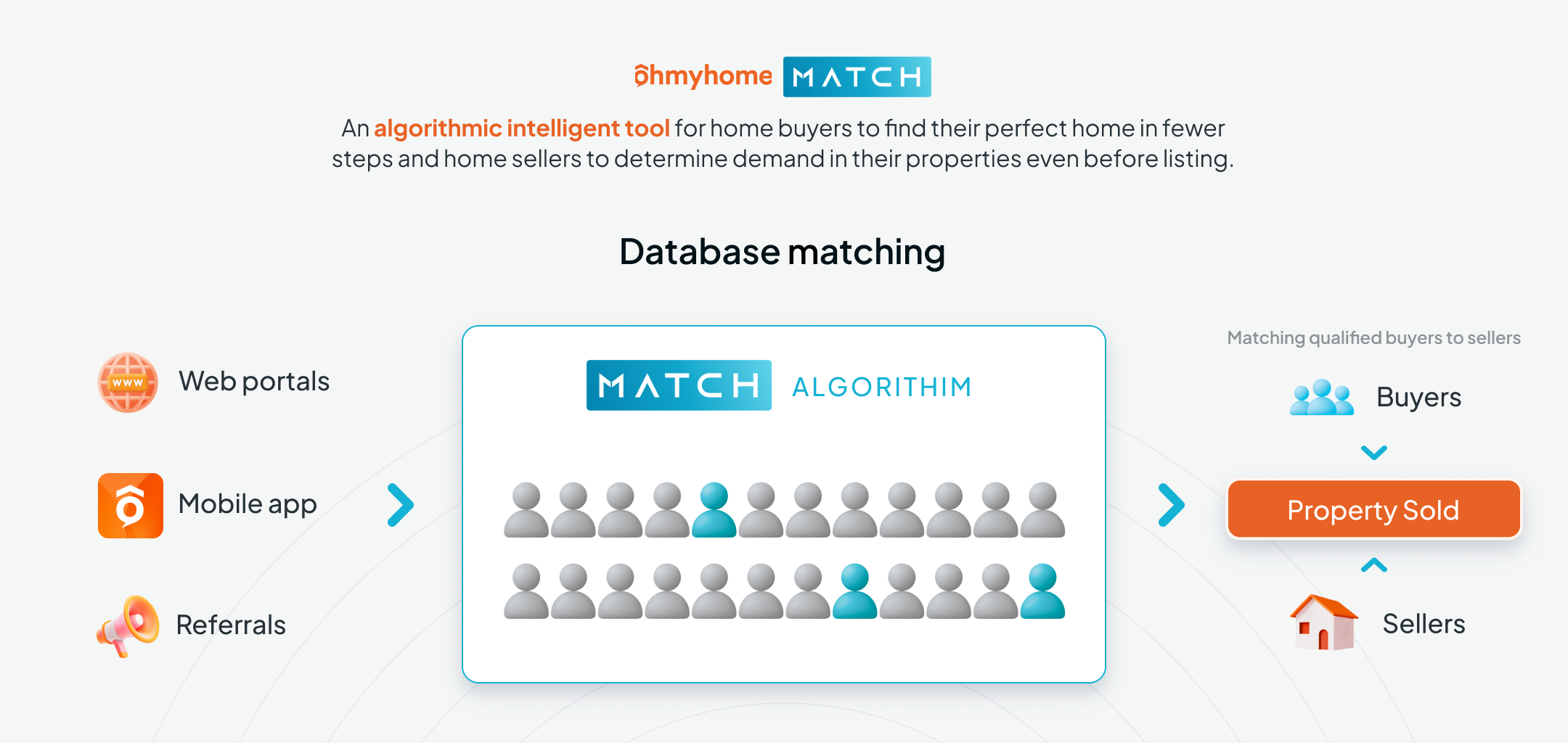
We’ve compiled a list of buyers’ preferences from this short questionnaire, which is easily accessible on the Ohmyhome website, that asks a series of questions ranging from a buyer’s budget to the location. This information is fed into an algorithm that matches sellers with buyers by sending the listings that match a buyer’s preferences directly to the buyer’s inbox.
What’s even better is that these buyers are not just casually shopping around for a home. They are actually ready to make a purchase if they find a unit that matches their preferences.
So when you engage Ohmyhome services, your listings have a higher chance of getting viewed by ready buyers who may call for viewing at any time.
Step 4: Watch Out for Property Agent Red Flags
Before you commit to a property agent, run through this list. A good agent will have none of these.
Red Flag
What It Looks Like
Why It Matters
Vague Past Experience
“Uh… yeah, I’ve sold some houses before” — can’t give specifics or transaction numbers.
A good agent should be able to cite recent deals in your area, with price and timeframe.
Limited Listing Activity
Doesn’t actively list properties online or across major portals.
Low visibility means fewer buyers. Your property deserves maximum exposure.
Pressure Tactics
“Just sign here, don’t worry about it!” — rushing you without clear explanation.
You have every right to understand what you’re signing. A trustworthy agent will always explain.
Poor Communication
Takes days to reply, especially after you’ve committed to working with them.
Property transactions have tight deadlines. Slow responses can cost you time and money.
Unrealistic Promises
“Your HDB can easily fetch a million!” — no data to back it up.
Good agents give you realistic valuations backed by comparable transactions, not sweet talk.
Step 5: Check How Responsive and Communicative Your Agent Is
While property agents are also workers who deserve boundaries and work-life balance, it is also equally important for you to receive regular updates on your transaction status when it comes to something as time-sensitive as selling your home.
After all, there could be penalties to pay if you fail to complete documentation within the stipulated time periods, such as losing a $1,000 option fee by defaulting on an Option to Purchase. Therefore, you don’t want a property agent who has a habit of leaving you hanging while you’re waiting for a reply.
So while we can’t expect property agents to respond immediately 24/7, reliable property agents should respond within one or two working days, more so if you’ve already committed to facilitating your transaction with them. This includes not just negotiations with the opposing party, but the aforementioned market trends and other relevant updates so that the process is as transparent as possible every step of the way.

At Ohmyhome, you won’t just have a property agent on your side, but a Relationship Manager as well. So when you have an urgent question, you can immediately drop them a text on WhatsApp and you will get a response in less than a minute.
Frequency of updates aside, the details within included updates are equally as important. Dealing with a property agent who lowers or even increases the valuation of a home arbitrarily without proper justification is likely to leave a bitter taste in your mouth afterwards.
Especially so when you discover further down the road that a similar property was transacted at a better price. Good property agents will be able to back up their valuation claims with relevant data.
Should You Go with a Major Agency or Independent Agent?
In your search for the best property agent, you’ll no doubt come across agents from an agency, or independent as well as boutique agents. What’s the difference, and who should you choose when selling a house?
The agents from major agencies have the advantage of a huge internal network, so their agents can easily tap into colleagues to find buyers. Plus, they usually have pretty solid training and all sorts of marketing firepower. And with tons of agents under their banner, your listing gets blasted out to a massive audience.
On the other hand, your independent or boutique agents offer a more personal touch. They might be more hands-on throughout the whole process and sometimes have a bit more wiggle room when it comes to commission.
Some questions you can ask your agent to help you decide are:
- Could you elaborate on the marketing support and resources your agency provides to facilitate the sale of my property?” (Focuses on the agency’s contribution to the seller’s goal.)
- “Will you be personally managing all property viewings, or will this responsibility be delegated to another representative?” (Clarifies the level of direct involvement from the agent.)
- “What is your established protocol for co-brokering with agents from external agencies to maximise buyer reach?” (Emphasizes collaboration within the broader market.)
Use This Property Agent Checklist Before You Commit
Before signing anything or handing over your listing, run through this checklist:
What to Check
How to Assess It
CEA Registration
Verify via CEA Public Register. Check name, contact, and registration number match.
Property Type Specialisation
Confirm their track record is in your property type and preferred area.
Transaction History
Review their CEA profile for recent completed deals, ideally in your town or district.
Communication Style
Do they respond within 1 to 2 working days? Do they explain things clearly?
Valuation Backed by Data
Can they justify their price estimate with comparable transactions?
Marketing Plan
Do they have a concrete plan for listing, staging, and promoting your property?
Fees and Transparency
Is their commission structure clear upfront, with no hidden charges?
Not Sure Where to Start? We Can Help.

Finding the right agent takes research, and hopefully this guide has made that process a little clearer. If you’d rather have someone take it from here, we’re ready when you are.
With Ohmyhome, you get a CEA-certified Super Agent ranked among the Top 1% in Singapore working on your behalf. That means selling your property at a price that reflects your home’s true value or potentially above your home’s actual value, a faster transaction, and someone who knows the process well enough to keep things moving without you having to chase.
And once the deal is done, you won’t have to start from scratch on everything else. Mortgage advisory, legal conveyancing, and renovation support are all available through Ohmyhome, so the whole journey stays in one place.
Whether you’re buying a new house, selling your current home, renting out your property, or looking for a place to rent, Ohmyhome has the best property agent for you.
Drop us a message on WhatsAppand we’ll match you with an agent who knows your property type and your area best.
Frequently Asked Questions
1. Do I need a property agent to buy or sell in Singapore, or can I do it myself?
You are not legally required to use a property agent. HDB resale transactions can be completed through the HDB Resale Portal without one, and private property transactions can also be handled independently. However, the process involves legal documents, tight deadlines, and negotiation, so most buyers and sellers choose to work with an agent to reduce the risk of costly mistakes.
2. What is the difference between a property agent and a property agency in Singapore?
A property agency is the licensed firm, such as ERA, PropNex, or Ohmyhome, while a property agent is the individual salesperson registered under that agency. When you hire an agent, you are hiring the person, not the firm. The agency provides training, tools, and a co-broking network, but the quality of your experience depends almost entirely on the individual agent you work with.
3. What should I do if I am unhappy with my property agent in Singapore?
Start by raising your concerns directly with the agent or their agency. Most issues around communication or process can be resolved at this level. If the problem is more serious, such as misrepresentation or a breach of the Code of Ethics, you can file a complaint with CEA through their official website. CEA has the authority to investigate and take disciplinary action against registered agents where necessary.
Disclaimer: All information in this article is accurate at the time of publication. Property market data, commission rates, and CEA regulations may change. Please verify the latest information with CEA or a licensed property agent before making any decisions.