Blog
The CEA’s Enhanced Public Register Gives You More Transparency on Property Agents and Agencies
Published 25 June 2026

TL;DR / Summary:
What changed: CEA’s enhanced Public Register now shows an agent’s enforcement record, not just licensing and transactions.
What’s new: New tools let you check past actions, compare agencies, and view agency profiles.
Why it matters: A referral isn’t all you have to go on anymore, you can check the property agent or agency’s actual record yourself.
A few months ago, a friend of mine chose her property agent because her colleague “swore by him”. No background check, just a good word over lunch. That’s still how most people do it, and usually it works out fine.
But sometimes “usually” isn’t enough. What if the agent who worked out great for your colleague didn’t work out the same for others? There used to be no way to know that for sure.
However, as of 10 June 2026, there’s actually something you can check now to back that referral up. The Council for Estate Agencies (CEA) enhanced its Public Register so you can now see an agent’s actual track record, not just their name and a good word.
Read on below to learn more about the new CEA changes.
What’s New on the CEA Public Register?
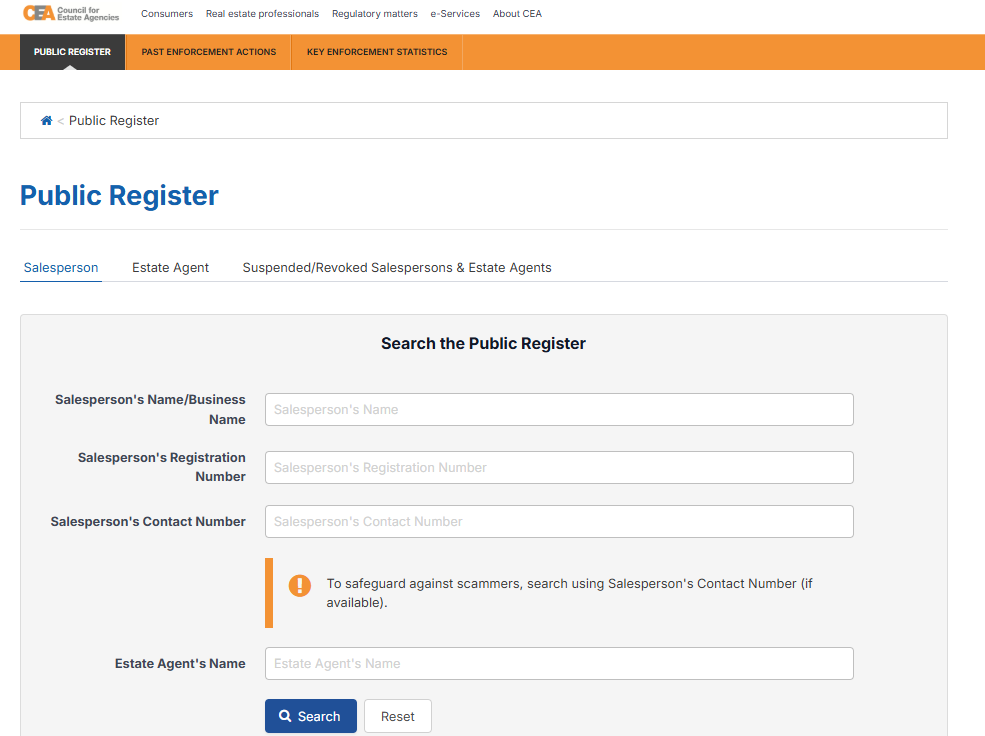
The CEA Public Register isn’t new. It’s existed since 2010, letting people check an agent’s registration status and transactions from the past 36 months. What changed on 10 June 2026 is how visible the enforcement side of that record is.
Before, if you wanted to know whether an agent had a disciplinary history, you’d search their name and dig through whatever came up. Now CEA has built specific tools to surface that information directly.
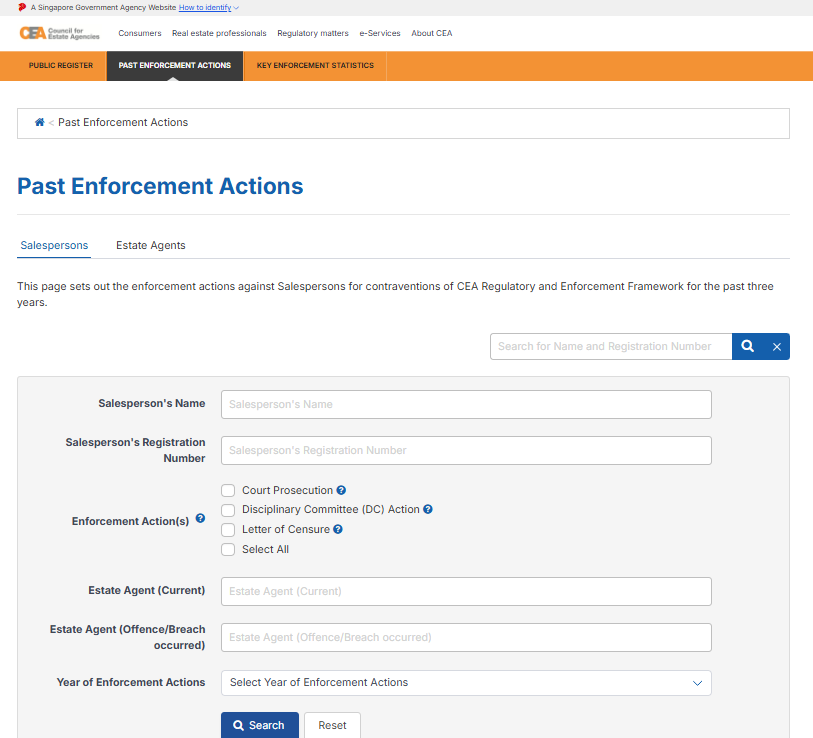
A “Past Enforcement Actions” page shows every enforcement action taken against any property agency or agent over the past three years, all in one view.
Alongside that is a “Key Enforcement Statistics” page, which breaks things down agency by agency, how many enforcement actions were taken against their agents, and how many agents each agency actually has.
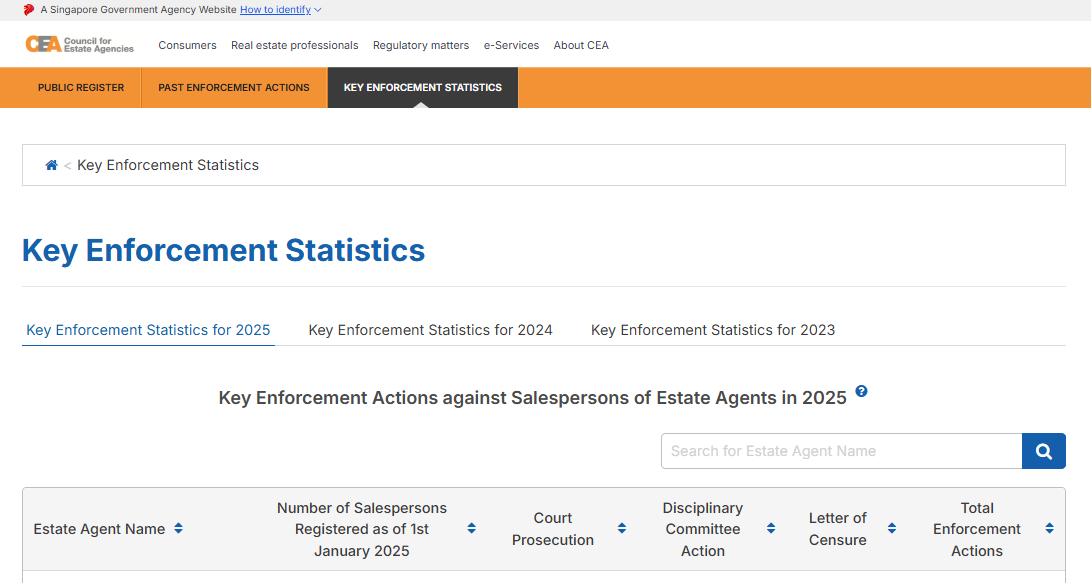
That second part matters more than it sounds: a large agency will naturally rack up more cases simply because it has more agents and transactions, so seeing the numbers side by side lets you judge fairly instead of assuming more cases automatically means a worse agency.
Speaking of which, those numbers come with a catch worth knowing: enforcement records are tied to the agency an agent was registered with at the time the breach happened, not necessarily where they work now. So if someone’s switched agencies recently, don’t assume their old record follows them to their new one in a way that’s unfair to either side.
And it’s not all about catching bad records either. Agents’ profile pages now also show any awards they’ve received. So the register isn’t only for spotting red flags, it’s also a place where good agents can actually show their track record, not just claim it.
A Guide on Checking A Property Agent’s Record in CEA Singapore
Why CEA Made This Website and Public Register Enhancement
For a while now, complaints against Singapore property agents have been piling up. According to CEA’s Annual Report 2024-2025, there were 1,271 complaints in 2024 alone, about 13% more than the year before.
A lot of the complaints were about poor service, such as punctuality issues, late responses, and communicating poorly.
But some complaints were a lot more serious than that: misleading ads and agents cutting corners on procedures they’re supposed to follow.
And in 2025, you could see those complaints actually turning into consequences: enforcement actions jumped to 82, up from 61 the year before.
None of this means the property industry is falling apart, though. If anything, it’s the opposite. It means the system’s actually catching things and following through, consistently enough that the numbers keep showing up. That’s what an industry maturing looks like, not one in trouble.
Why This CEA Website and Public Register Enhancement Matters For Consumers
Say you’re selling your only property. Years of savings, tied up in one transaction. Someone recommends an agent, a friend, a colleague, whoever. They’re easy to talk to, quick to respond at first, say all the right things. You go with them.
Most of the time, that’s exactly how it should go. But a property deal is one of those rare moments where “most of the time” doesn’t really cover you, a missed disclosure, a badly handled negotiation, a shortcut on procedure that ends up delaying your sale by months. When something does go wrong, it’s rarely small.
The Benefits of Working With a Seller Agent (and How to Pick One)
This update gives you something you didn’t really have before: a way to check, not just hope. You’re not choosing between trusting the recommendation or doing your own homework, you can do both. Take the referral, then spend two minutes seeing if that person’s actual record backs it up.
One honest caveat, though. A clean record doesn’t mean someone’s great at their job, it just means nothing’s been flagged yet. And a big agency with a handful of minor cases isn’t necessarily worse than a small one with a single serious case, the numbers need context.

What This Transparency Means for the Real Estate Industry
When enforcement records are out in the open like this, property agents and agencies actually have a reason to keep their standards up, not because someone’s watching more closely, but because their real record is now part of how people judge them, right alongside their pitch, their reviews, the referrals they get.
And that’s a good thing if you’re an agent doing this properly. Your track record can finally speak for itself, not just your sales numbers, not just how good you sound in that first meeting.
Looking for a Property Agent You Can Trust?

Word of mouth isn’t going away, and it shouldn’t. People will keep recommending agents they trust, and most of those recommendations will keep working out fine. But for the first time, that trust doesn’t have to stand alone. You can check it.
Looking for an agent you can trust with your property journey? Ohmyhome‘s Super Agents are vetted, experienced, and ready to help with your next property move – whether you’re planning to sell your current home or buy a new property.
Drop us a message on WhatsApp to get started.

Frequently Asked Questions
Does an agent’s enforcement record follow them if they switch agencies?
No, an agent’s enforcement record stays with the agency they were registered with at the time the breach happened, not their current one. So if an agent recently switched agencies, that past action stays tied to their old agency on the register, not their new one. If you’re checking someone who’s recently moved, it’s worth looking at both.
What’s the difference between a Letter of Censure and a Disciplinary Committee action?
A Letter of Censure is a formal written reprimand for less severe breaches, while a Disciplinary Committee action is more serious and can come with heavier penalties, including suspension. CEA’s Public Register shows which type of action was taken, not just that something happened, so you can gauge how serious a past issue actually was, not just that one exists.
How far back does the CEA Public Register’s enforcement history actually go?
The register currently shows enforcement actions from 2023 to 2025, and CEA has said it’ll display the past three years on a rolling basis going forward. So anything older than that window won’t show up. If an agent had an issue further back, it won’t appear here, only their recent three-year history will.
Does checking the CEA Public Register cost anything or require an account?
No, checking the CEA Public Register is completely free and doesn’t require creating an account or logging in. You can search any property agent or agency by name directly on CEA’s website. It’s designed to be a quick, no-friction check, nothing to sign up for, nothing to pay, just search and read.