Blog
3 Ways to Get a Higher Home Loan Amid Increasing Interest Rates
Published 30 September 2025
TL;DR / Summary:
– HDB loan rate stays at 2.6%, but a 3% “interest rate floor” caps how much you can borrow.
– Bank loans are stress-tested at 4%, cutting loan eligibility by up to 40% vs. pre-cooling-measure rates.
– Boost your loan amount by counting eligible assets as income, clearing debts, or maxing your loan tenure (up to 35 years).
– HDB loans need a 20% downpayment, with that gap now paid out-of-pocket.
There’ve been a few property moments that have impacted buyers and flat owners lately. First, there’s the 15-month wait-out period, which still stops private property owners from selling their home and buying a HDB flat right away. Then there’s rising interest rates, which affect almost everyone taking out a home loan today.
The good news? Your borrowing power isn’t fixed. Here’s how to qualify for a higher loan amount in Singapore.
How to Increase Home Loan Amount You Can Borrow in 3 Ways

Here are three practical ways to boost your loan eligibility, even as interest rates climb.
1. Include your Eligible Financial Asset (EFA) Value to Your Gross Monthly Income
Got savings, stocks, or investments sitting around? Banks let you count some of these toward your income when you apply for a loan, which can help you qualify to borrow more.
Here’s how it works: the bank doesn’t add the full value right away. Instead, they spread it out over 4 years (48 months), so only a portion counts toward your income each month. You’ll also get a better boost if you “pledge” the asset, meaning you agree to lock it with the bank for those 4 years, instead of leaving it free to use (“unpledged”), which counts for less.
So while this won’t instantly bump up your loan amount, having these assets on hand can still help you qualify for a higher loan over time.
2. Pay Off Other Existing Debts
On the other hand, you can pay off your other existing loans, such as car loans, student loans, and credit card loans, to raise your loan eligibility. That’s because banks look at how much debt you’re already paying off each month, and the less debt you have, the more room you free up to borrow for your home.
3. Max Out Your Loan Tenure
Stretching out your loan tenure, or how long you take to repay it, can help you qualify to borrow more. That’s because a longer tenure means smaller monthly payments, which gives banks more confidence that you can comfortably afford the loan.
If you’re taking a HDB loan, the maximum loan tenure is 25 years or up to age 65, whichever is shorter. For a bank loan, the maximum loan tenure is 30 years if you’re buying a HDB flat, and 35 years if you’re getting a private property.
HDB Interest Rate Floor Rise to 3%
The strategies above can help you qualify for more, but it also helps to understand what’s working against your borrowing power in the first place. One of the biggest factors is the interest rate floor, which sits at 3%.
To be clear, this isn’t the rate you’re actually charged. The interest rate for an HDB loan is still 2.6%, pegged 0.1% above the CPF Ordinary Account (OA) rate, currently at 2.5%. The interest rate floor is a separate figure banks and HDB use to calculate how much you’re allowed to borrow. It basically acts as a “stress test” that ensures you, the borrower, can comfortably afford your home purchase and service your loan in case the interest rate does rise to 4%, for example.

Possibility of CPF OA Rate Also Increasing
Now, one of the reasons this matter is because the HDB interest rate is pegged to the CPF OA rate, and the rise of the interest rate floor gives way to the possibility that the CPF OA will also increase.
Bank rates have already gone up a few times this year, with the current interest rate now up to 4% for financial institutions such as DBS, OCBC, and UOB.
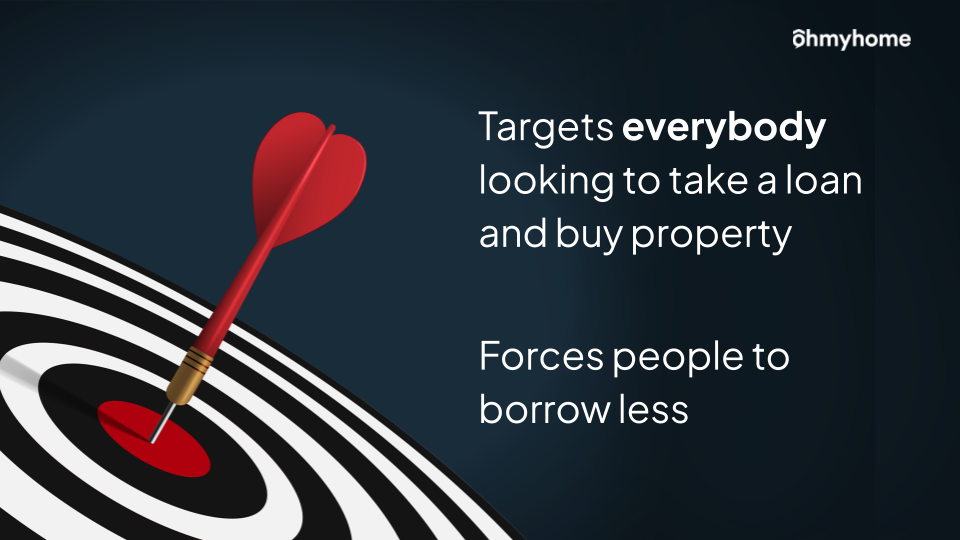
Another reason why the interest rate increase is important is that it directly impacts the affordability of your home because you’ll be forced to borrow less.
The reason why this matters is that when the interest rate floor increases, the amount you can borrow from either HDB or the bank will then decrease as a result.
The Impact of Rising Interest Rates (in Numbers)
Say you take a $1 million loan for 25 years. Before the cooling measures, with the bank rates at around 1.2%, you would only have to pay at least $3.9K per month. Now that the interest rates have risen to over 4%, you will have to pay about $5.4K a month, which is at least $1.5K more. That’s a 40% increase for the same housing loan.
This is pretty much the reality that homeowners are facing right now and the reason why many are dealing with ‘mortgage stress’.
A survey conducted by OCBC shows that about 40% of borrowers face difficulties in paying off their mortgage loans, up from the 31% who dealt with the same stress in 2021.
On top of the rising interest rates, there’s also the lower Loan-to-Value limit, which dropped from 85% to 80%. Though this only affects those who have or will be taking a HDB loan, you will still have to borrow less — and that 5% will have to now be paid out-of-pocket.
During the Consumer Seminar, UOB’s Mortgage Specialist Desmond Chua shared ways on how to increase mortgage loan amount:
- Increase your income
- Reduce your debt obligations
- Max out your loan period
Feeling the Mortgage Stress Too?
Discover the best home loan rates across all the banks, and let us draw the comparisons for you. We’ll find you the best loan tailored to your needs, free of charge.
For your other homebuying, renting, or selling needs, our Super Agents are also available to assist you. Whether you need help in buying a new home, property valuation or listing your home, our Super Agents have you covered.
Fill out the booking form below or WhatsApp us to get started.
Frequently Asked Questions
Should I get an HDB loan or a bank loan if I’m trying to borrow the maximum amount?
Go with a bank loan if maximising your loan amount is the priority, since its longer tenure, up to 30 years for a HDB flat versus HDB’s 25-year cap, lowers your monthly instalment and frees up more room under MSR and TDSR limits. But if rate stability matters more to you than borrowing the absolute maximum, a HDB loan’s fixed 2.6% rate and no lock-in period offer more predictability, even with a smaller loan ceiling.
What can I do if my approved loan amount still isn’t enough to cover the home or property I want?
You can appeal to HDB with updated documents if your financial situation has improved, such as a pay raise or cleared debts. If you’re unable to meet TDSR and MSR requirements, your other options include buying a more affordable property or applying jointly with a partner to combine income. A bank loan may also offer more flexibility if HDB’s offer falls short.
Does my age affect how much I can borrow, even if my income is strong?
Yes, age affects your loan amount because your loan tenure is capped at 25 years for HDB loans and 30 years for bank loans, and if you’re older, your loan amount may be lower than expected because it must end by age 65 for HDB or 75 for bank loans. A shorter tenure means higher monthly payments, which can push you past the borrowing limits even with a solid income.
Why would I get a lower loan amount than expected even if I meet HDB’s income requirements?
Meeting the income ceiling doesn’t guarantee the full loan amount, since HDB and banks still check whether your monthly repayments fit within the Mortgage Servicing Ratio (30% of income) and Total Debt Servicing Ratio (55% of income). Existing debts, like a car loan, can push you past these limits even if your gross income looks sufficient on paper.